Every project creates knowledge that is written down nowhere. Without lessons learned, it leaves with the team.
- What for
- Capture experience and pass it on
- When
- At the end of the project, on long projects also after milestones
- Who
- Project team, with the client if needed
- Result
- Concrete recommendations for future projects
What are lessons learned?
Lessons learned are the collected experience from a project. Three questions form the core:
- What went well? That should run the same way next time.
- What could have gone better? This is where the biggest learning lies.
- What do we take with us? Concrete recommendations for future projects.
The difference from a retrospective: A retrospective takes place regularly during the project and improves teamwork. Lessons learned come at the end and help the next projects.
Step by step
- Schedule it promptly. Ideally within two weeks of closing, while memories are fresh.
- Bring the facts. Plan versus actual for dates and budget, milestones and risks that occurred.
- Collect in silence first. Everyone writes down their own notes, then you compare.
- Ask for causes. Not just what happened, but why.
- Formulate recommendations. Concrete and actionable, one sentence per insight.
- File it where it can be found. And actually read it at the next kickoff.
Example: website relaunch
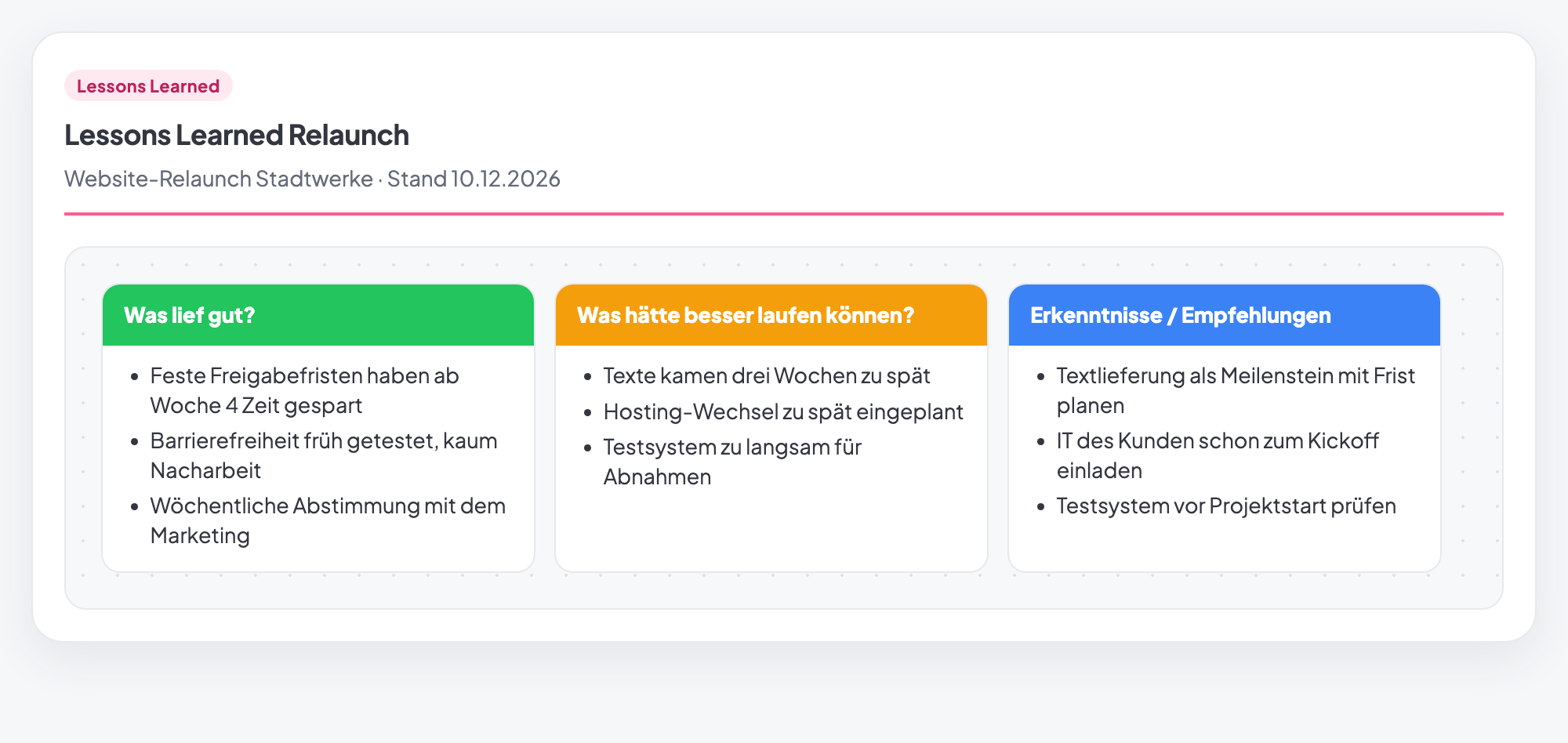
After go-live, the team meets. The image above shows the result:
- Good: Fixed approval deadlines saved time from week 4 on. Accessibility was tested early, and coordination with marketing happened weekly.
- Better: The copy arrived three weeks late. The hosting switch was scheduled too late, and the test system was too slow for acceptance tests.
- Take with us: Plan copy delivery as a milestone with a deadline. Invite the client's IT to the kickoff. Check the test system before the project starts.
A pre-mortem at the project start could have predicted many of these points.
Common mistakes
- Looking for culprits. Then nobody speaks openly about problems anymore.
- Too late. After months, nobody remembers the details.
- Problems only. What went well is just as valuable.
- Vague insights. "Better communication" changes nothing. "Three business days for approvals" does.
- File and forget. Lessons learned only work if the next project reads them.
Lessons learned in Tasktopus AI
- Three columns on the project: "What went well?", "What could have gone better?" and "Insights / recommendations". The method stays saved with the project.
- Suggested at project end: For a project almost finished or closed, lessons learned appears first in the method picker, under "Fits the project now".
- Print as a sheet: The "Sheet" view shows the three columns in color, for example for the final report.
- Plan: included in all plans, including the free Starter.
Capture lessons learned for free
Included in the free Starter plan. No credit card, no installation.
Start for freeFrequently asked questions
What is the difference between lessons learned and a retrospective?
A retrospective takes place regularly during the project and improves teamwork. Lessons learned come at the end and help future projects.
When is the best time?
Shortly after the project ends, while everyone still remembers the details. On long projects, an extra round after key milestones pays off.
Who should facilitate?
Ideally someone other than the project lead. That way the project lead can also speak openly about their own mistakes.
Is lessons learned free in Tasktopus AI?
Yes. The method is one of the 12 core methods in the free Starter plan. Starter stays free for good, for up to 3 projects and 5 members.