A SWOT analysis answers a simple question: Where do we stand, and what follows from that? It is quick to do, but only worth much if it ends in concrete actions.
- What for
- Clarify the starting position before you plan or decide
- When
- At project start, before big decisions, when changing course
- Who
- Project lead with three to eight participants
- Result
- Four filled fields and the actions derived from them
What is a SWOT analysis?
SWOT stands for Strengths, Weaknesses, Opportunities, and Threats. The four fields come from two questions:
- Internal or external? Strengths and weaknesses lie within the project itself: team, knowledge, budget, time, tools. Opportunities and threats come from outside: client, market, laws, suppliers, technology.
- Helpful or harmful? Strengths and opportunities help the project; weaknesses and threats hurt it.
The distinction matters: You can change internal points directly. For external points, you can only prepare. The method comes from corporate strategy but works just as well for a single project.
When is a SWOT analysis worth it?
- At project start, so everyone understands the starting position the same way.
- Before a decision, such as whether to submit a bid or continue a project.
- When a project stalls and you want to reassess the situation.
It is less suited to finding the cause of a specific problem. The Ishikawa diagram is better for that.
Step by step
- Set the question. What does the analysis refer to? “Will we make the relaunch by November 30?” leads to better answers than “our project”.
- Collect internal points. Note strengths and weaknesses. Ideally, everyone first writes silently on their own, then you pool the results. That way, not only the loudest voices get heard.
- Collect external points. Add opportunities and threats from the environment. What is the client doing? What is changing in the market? What depends on third parties?
- Condense. Merge duplicates, make vague points concrete, and cut each field down to three to five points.
- Derive strategies. Combine the fields: Use strengths to seize opportunities. Remove weaknesses that block an opportunity. Use strengths to cushion threats. And avoid letting a weakness meet a threat.
- Record actions. Every action gets an owner and a due date. Major threats also belong in the risk register.
Example: website relaunch
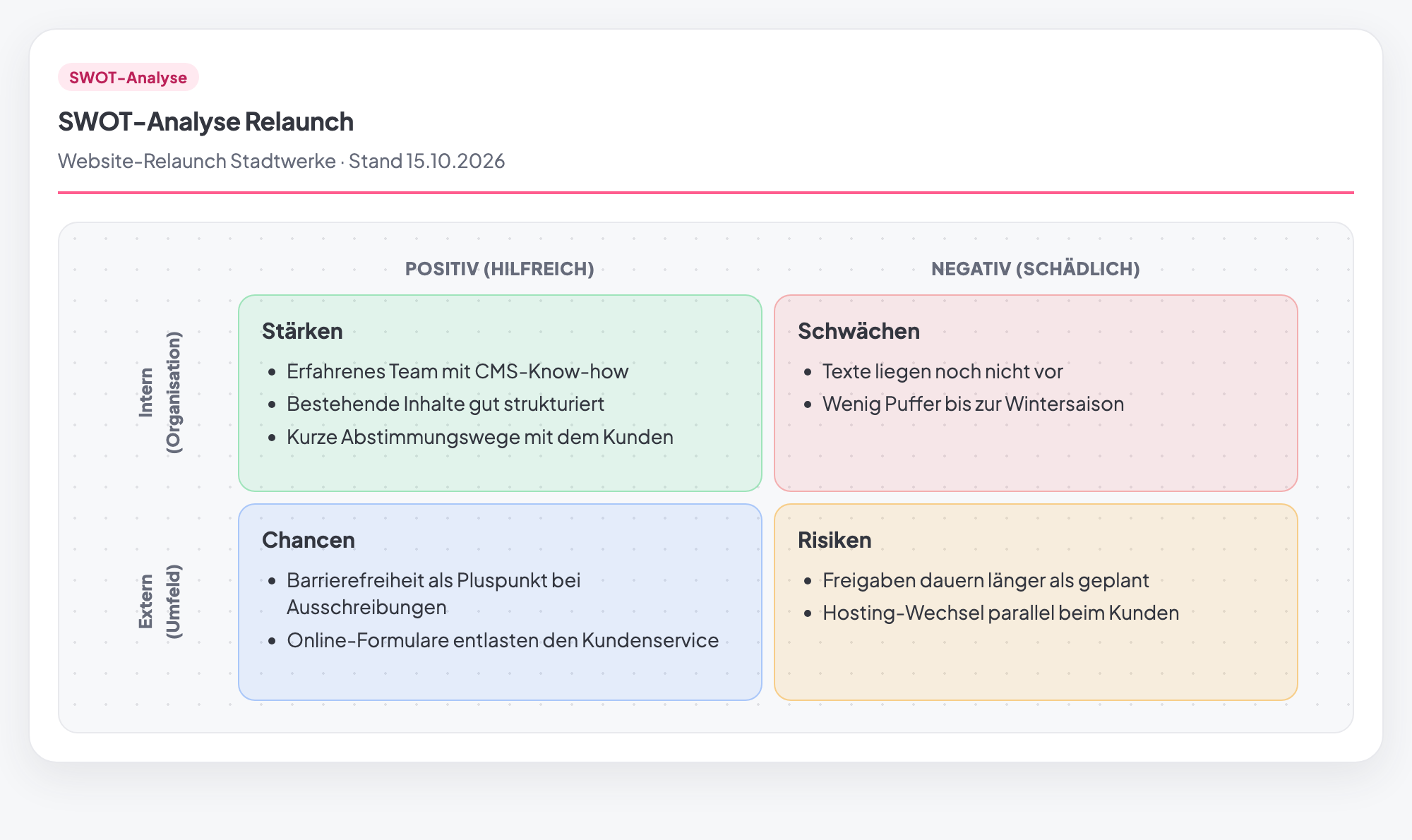
An agency is rebuilding the website of a municipal utility. The team knows the content management system (CMS) well, and the existing content is cleanly structured. But the new copy is still missing, and there is little buffer before the winter season. External threats: slow approvals, and a hosting migration the client is planning at the same time. On the plus side, accessibility scores points in tenders, and online forms can take load off customer service.
The screenshot above shows the four fields. Two actions the team derives from them:
- Weakness meets threat: Missing copy and slow approvals together put the deadline at risk. So the team agrees on fixed approval deadlines and plans copy delivery as a milestone.
- Strength against threat: The team’s CMS know-how helps to support the hosting migration technically instead of just waiting for it.
Common mistakes
- Mixing internal and external. “The client approves late” is not a team weakness but an external threat.
- Staying too general. “Communication” is not a finding. “Approvals have no fixed deadlines” is.
- Stopping at the list. Without derived actions, the SWOT stays an inventory.
- Only one perspective. If only the project lead writes, the blind spots are missing.
- Doing it once and forgetting it. When the situation changes significantly, a quick look at the four fields pays off.
SWOT analysis in Tasktopus AI
- Fill it in on the project: Pick the method, give it a title, fill the four fields. Everyone in the project sees the current state.
- ✨ Tako pre-fills: Tasktopus AI adds suggestions from the project. Overdue, blocked, or unassigned tasks and overload go to weaknesses. Overdue milestones, a tight budget, and risks already recorded go to threats. Completed tasks and reached milestones become strengths; free capacity becomes an opportunity. This is rule-based from the project data, without a language model. Nothing is saved until you save.
- Add as a risk: Select weaknesses and threats to move them into the project’s risk register. You can adjust the level beforehand; existing risks are skipped.
- Print as a sheet: The “Sheet” view shows the classic four-field matrix with internal and external, helpful and harmful. With zoom and print.
- Suggested at project start: For new projects, the SWOT analysis appears at the top of the method picker under “Fits the project now”.
- Plan: Pro and up. Included in the 14-day trial.
Fill in your SWOT analysis right on the project
Pro and up, included free in the 14-day trial. No credit card, no installation.
Start for freeFrequently asked questions
What is the difference between weaknesses and threats?
Weaknesses lie within the project, and you can change them directly, such as missing know-how in the team. Threats come from outside. You can prevent them or prepare for them, but you cannot switch them off.
How many points belong in each field?
Three to five meaningful points are usually enough. A long list looks thorough but dilutes the result. Better concrete than complete.
What is a TOWS analysis?
The TOWS analysis is the second step of a SWOT. It combines the fields into strategies: strengths with opportunities, weaknesses with opportunities, strengths with threats, weaknesses with threats. That is exactly what step 5 of the guide describes.
Is the SWOT analysis included in the free Starter?
No, it is one of the Pro methods. In Starter you use 12 core methods, including stakeholder analysis, risk matrix, SMART goals, and RACI matrix. In the 14-day trial you can try all 102 methods.