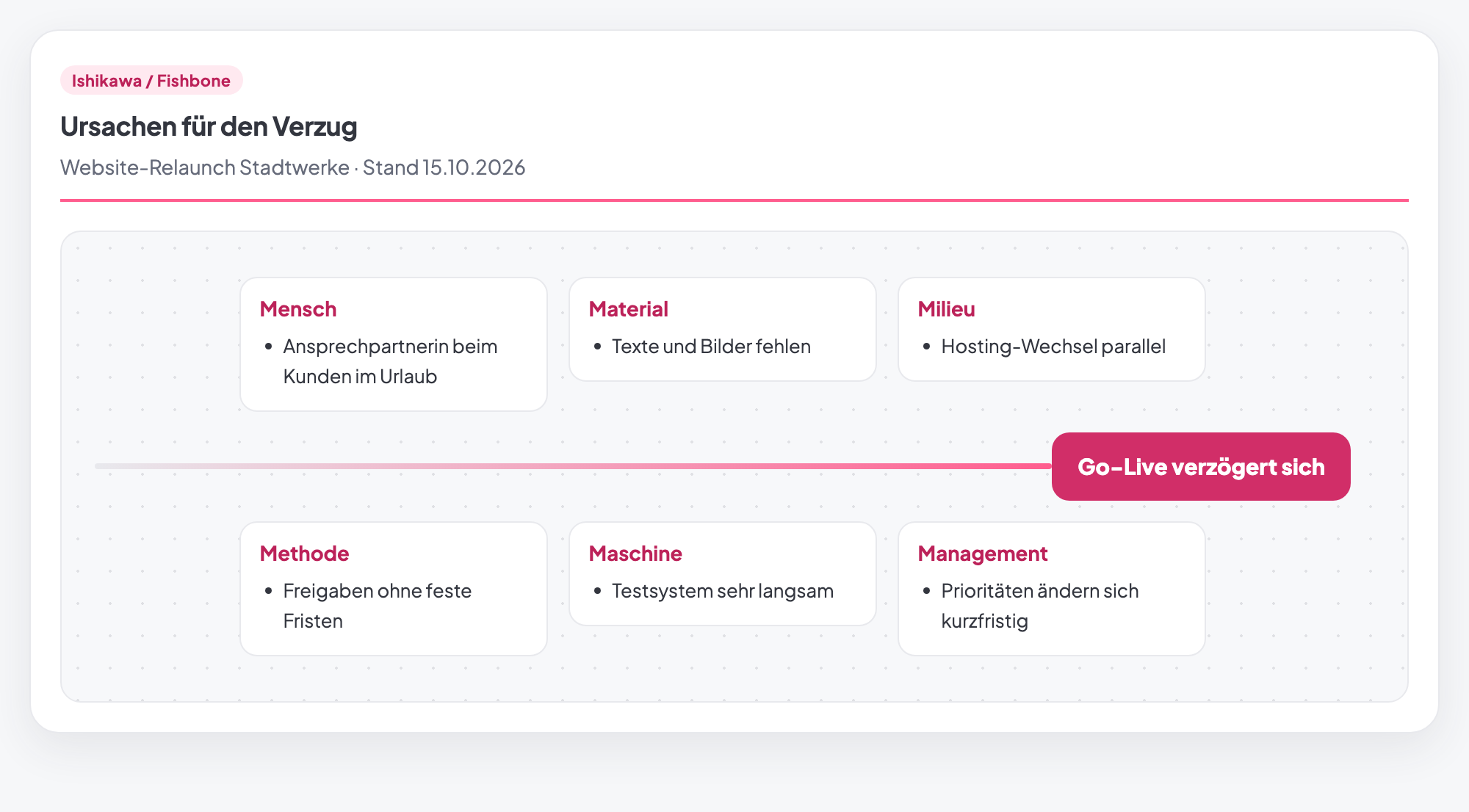
When a project stalls, the first explanation is rarely the whole truth. The Ishikawa diagram makes sure you look in every direction before you decide on actions.
- What for
- Find the causes of a specific problem
- When
- When a problem occurs or keeps coming back, also in retrospectives
- Who
- One facilitator and three to eight people who know the problem
- Result
- Sorted causes and the most likely root causes
What is an Ishikawa diagram?
The diagram goes back to the Japanese quality expert Kaoru Ishikawa. It looks like a fish skeleton: the head holds the problem, meaning the effect. The bones are categories that possible causes hang on.
The 6 Ms have proven themselves as categories:
- Man: people’s knowledge, experience, availability, coordination.
- Method: processes, rules, approvals.
- Material: deliveries, content, data.
- Machine: technology, tools, systems.
- Milieu: the environment, meaning customer, market, outside influences.
- Management: priorities, resources, decisions.
Some sources use Measurement as the sixth M instead of Management. The categories are a starting point, not a law. If one does not fit, leave it out.
Step by step
- Describe the problem precisely. “Go-live is delayed by three weeks” instead of “The project is going badly”. The problem goes in the head of the fish.
- Set the categories. Use the 6 Ms as bones and adjust them if needed.
- Collect causes. Note possible causes for each category. Collect first, do not evaluate yet.
- Dig deeper. Ask for each cause: Why is that? This produces sub-causes, which are often closer to the solution. For a single cause, the 5 Whys method works well too.
- Select the root causes. Evaluate together, for example with dot votes, and check the assumptions against data where possible.
- Derive actions. For the root causes, define actions with owners and a due date.
Example: website relaunch
The go-live is at risk of slipping. The team collects causes (see image above): the customer’s contact person is on vacation (Man). Approvals have no fixed deadlines (Method). Copy and images are missing (Material). The test system is very slow (Machine). The customer is switching hosting at the same time (Milieu). Priorities change at short notice (Management).
In the evaluation, the approvals and the missing copy come out on top because they reinforce each other. The actions: an approval deadline of three working days, a stand-in for the vacation period, and copy delivery as its own milestone.
Typical mistakes
- Vague problem. If the head of the fish is vague, so are the causes.
- Solutions instead of causes. “More staff” is an idea for later, not a cause.
- Looking for culprits. The “Man” category asks about conditions, not about individual people’s mistakes. Otherwise nobody speaks openly for long.
- Not checking assumptions. What sounds plausible is not necessarily true.
- Having to fill every category. An empty bone is a finding too.
Ishikawa diagram in Tasktopus AI
- Fill in on your project: one field for problem and effect, plus six lists for Man, Method, Material, Machine, Milieu and Management.
- Print as a fishbone: The “Sheet” view draws the diagram with the problem as the head and the categories above and below. With zoom and print.
- Quick to find: In the method picker you find the method under “Analysis” or via search, for example with “Fishbone”.
- From cause to task: You create the agreed actions as tasks in the project, with owners and a due date.
- Plan: Pro and up. The method is included in the 14-day trial.
Try the Ishikawa diagram on your project
Pro and up, included free in the 14-day trial. No credit card, no installation.
Start for freeFrequently asked questions
What do the 6 Ms stand for?
Man, Method, Material, Machine, Milieu and Management. In some sources, Measurement replaces Management. The categories work well for projects and office processes; manufacturing has further variants.
What is the difference between Ishikawa and 5 Whys?
The Ishikawa diagram searches broadly for many possible causes. The 5 Whys method digs deep into a single cause. They combine well: collect broadly first, then follow the key causes by asking “Why?” five times.
Does the Ishikawa diagram also work outside manufacturing?
Yes. It originated in quality management. But the question of causes comes up in every project, in services and in administration.
Is the Ishikawa diagram included in the free Starter plan?
No, it is one of the Pro methods. During the 14-day trial you can use all 102 methods for free, including the Ishikawa diagram.