A post-mortem asks after the end what went wrong. The pre-mortem asks the same question at the start, while you can still change course.
- Purpose
- Find hidden risks and prevent them
- When
- At project start or before major decisions
- Who
- The project team, as mixed as possible
- Result
- Possible reasons for failure, each with a countermeasure
What is a pre-mortem?
The psychologist Gary Klein made the method popular. The idea is a small shift in perspective:
- The question "What could go wrong?" often makes people hold back. Nobody wants to be seen as the naysayer.
- The question "It went wrong. Why?" turns concerns into the task. Now finding reasons is exactly what is wanted.
This brings up risks that would otherwise drown in the usual optimism of a project start.
Step by step
- Describe the failure. Make it concrete, with a date: "It's December. The go-live has collapsed, the budget is blown."
- Collect reasons in silence. Each person spends five to ten minutes writing down why it failed.
- Read out in turn. Collect all reasons, no discussion yet.
- Pick the most important reasons. Which are likely and have serious consequences?
- Define countermeasures. One measure with an owner for every important reason.
- Transfer to the risk register. So the risks stay on the radar throughout the project.
Example: website relaunch
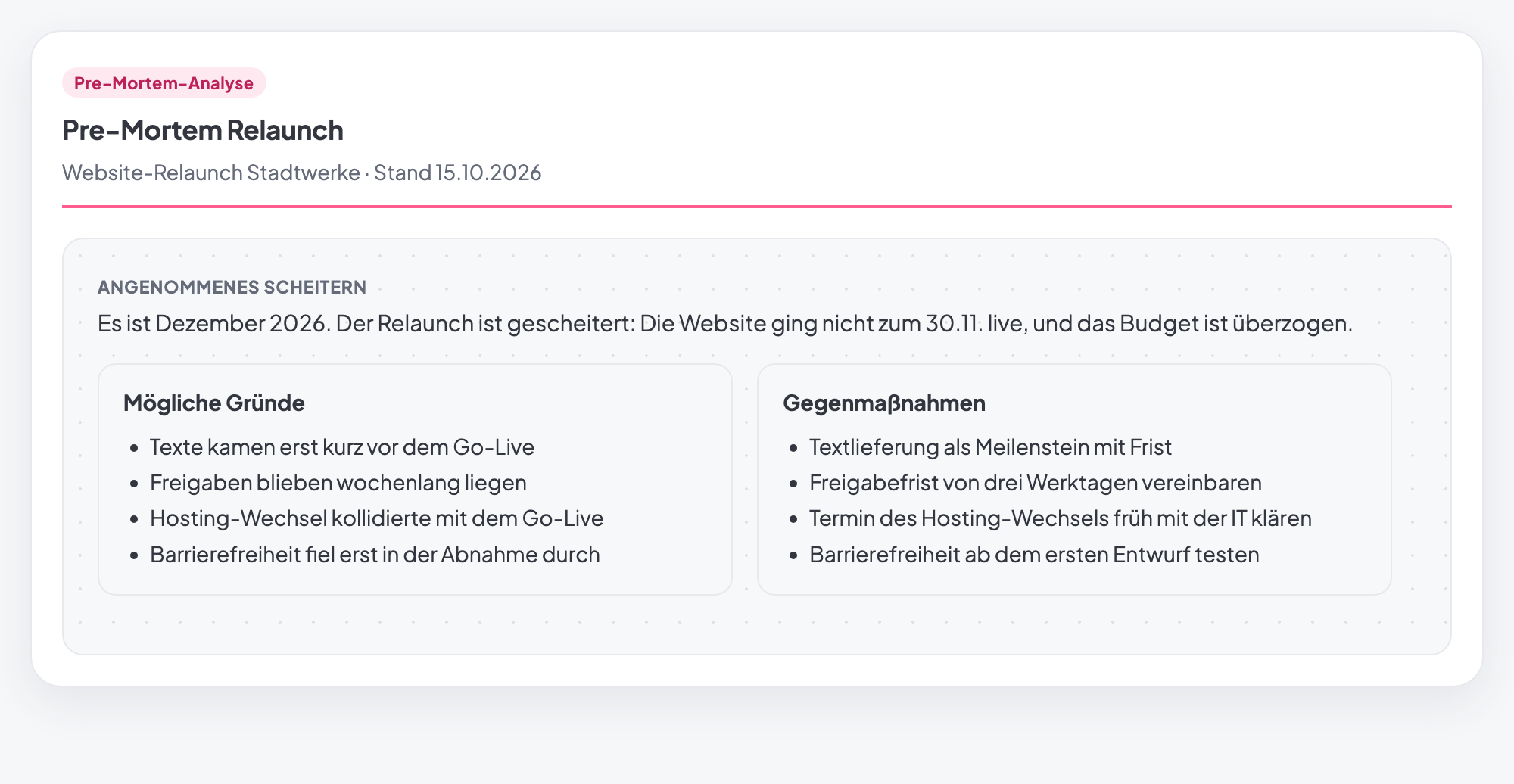
At the start, the team imagines: it's December 2026 and the relaunch has failed. The image above shows the reasons and the countermeasures:
- Copy arrived too late: make copy delivery a milestone with a deadline.
- Approvals stalled: agree on a three-business-day approval deadline.
- Hosting migration clashed: settle the date early with the utility company's IT.
- Accessibility failed: test from the first draft onward.
The team then rates the most important reasons in the risk matrix.
Common mistakes
- Vague scenario. "It didn't go well" yields little. A concrete failure yields concrete reasons.
- Discussing right away. Collect first, then evaluate. Otherwise the loudest voices win.
- Only the project lead talks. The most valuable clues often come from the team.
- No measures. Without countermeasures it stays a gloomy exercise.
- Assigning blame. It's about conditions, not people.
Pre-mortem in Tasktopus AI
- Fill it in on the project: one field for the assumed failure, plus the lists "possible reasons" and "countermeasures."
- ✨ Tako pre-fills: If the scenario is empty, Tasktopus AI inserts a suggestion. It also adds reasons from the project, each with a countermeasure. Sources are overdue tasks and milestones, blockers, tasks without an owner, overload and budget. This is rule-based from the project data, with no language model. Nothing is stored until you save.
- Adopt as a risk: Select possible reasons and move them into the project's risk register at level "high." You can change the level beforehand.
- Suggested when things get tight: For a project flagged at risk, the pre-mortem appears first in the method picker, under "Fits the project right now."
- Plan: Pro and up. Included in the 14-day trial.
Try the pre-mortem on your project
Pro and up, included free in the 14-day trial. No credit card, no installation.
Start for freeFrequently asked questions
What is the difference between a pre-mortem and a post-mortem?
A post-mortem looks back after the end and asks what went wrong. A pre-mortem assumes the failure at the start, while you can still change course.
How does it differ from the risk matrix?
The pre-mortem finds risks, including uncomfortable ones. The risk matrix rates them by probability and impact. Together they make solid risk management.
How long does a pre-mortem take?
Usually 45 to 60 minutes. The most important part is the ten minutes in which everyone writes down reasons in silence.
Is the pre-mortem included in the free Starter plan?
No, it is one of the Pro methods. In the 14-day trial you can try all 102 methods for free, including the pre-mortem.