What is missing from the work breakdown structure gets forgotten or done twice. It answers one simple question: What does the project consist of?
- Purpose
- Capture the full project scope completely
- When
- After the project charter, before planning time and costs
- Who
- Project lead together with the team
- Result
- Numbered list of all work packages
What is a work breakdown structure?
The work breakdown structure, WBS for short, breaks the project down level by level:
- Project: the top level, for example the website relaunch.
- Sub-tasks: large blocks such as concept, design or build.
- Work packages: the lowest level. Each has a clear result, one owner and an effort you can estimate.
You can structure by phases (concept, design, build) or by components (home page, forms, content). The numbers 1, 1.1, 1.1.1 show what belongs where.
The 100 percent rule matters: all parts together add up to exactly the whole project. Nothing is missing, and nothing appears twice.
Step by step
- Clarify the scope. What should exist at the end? The project charter and SMART goals are the foundation.
- Choose a structure. By phases is the easiest for most projects.
- Form sub-tasks. Four to eight blocks on the first level are usually enough.
- Derive work packages. Break down until one person can own it and estimate the effort.
- Number them. Every line gets a unique number.
- Check with the team. Is anything missing? Is anything in twice? Only then come schedule and costs.
Example: website relaunch
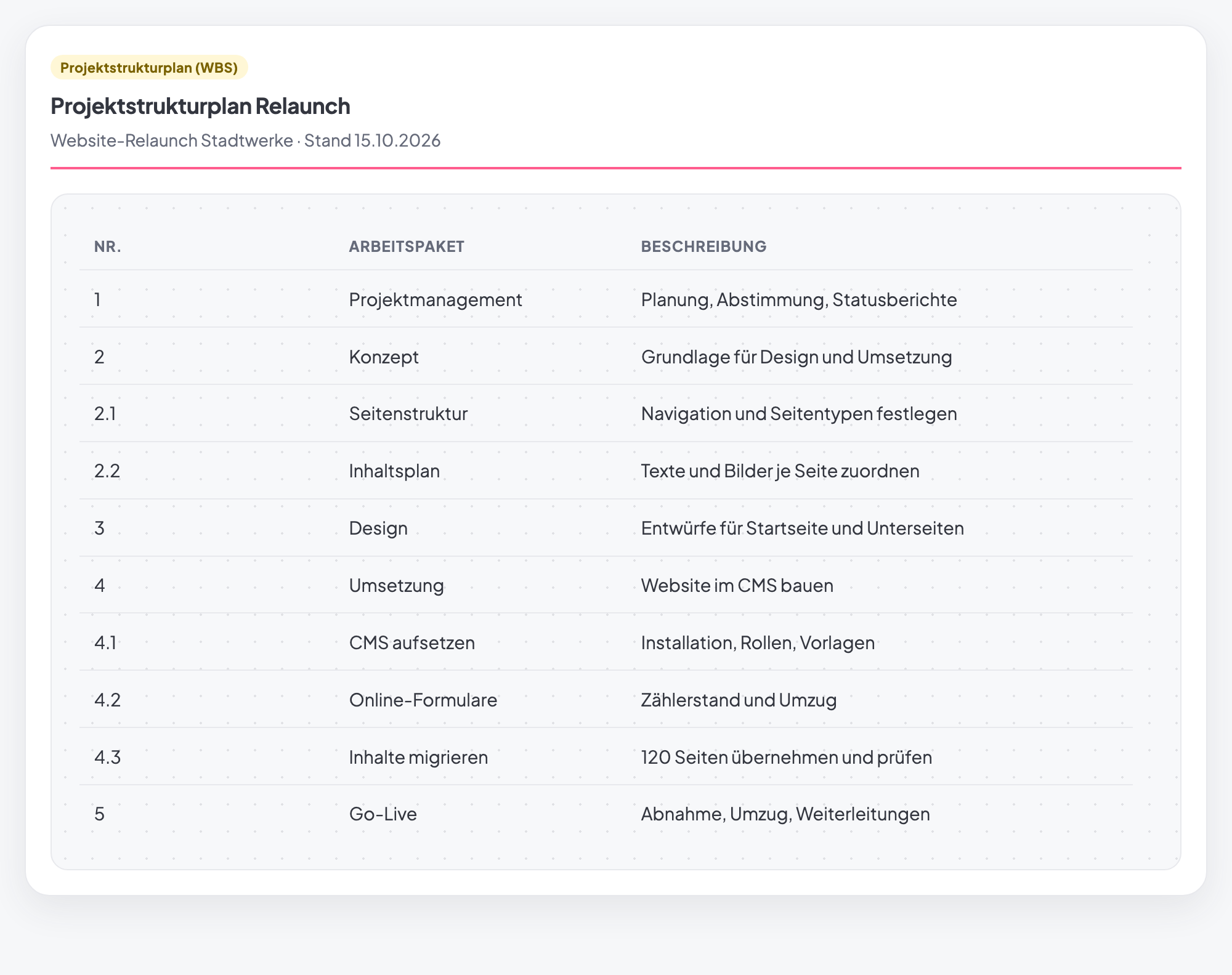
In the image above, the relaunch is structured by phases: project management, concept, design, build and go-live. Two things stand out:
- Project management is its own package. Coordination and status reports take time and are easily forgotten otherwise.
- "Migrate content" is big. 120 pages are too much for one package. Another level pays off here, for example by area: electricity, water and service.
Common mistakes
- Forgetting project management. Then a large share of the effort is missing.
- Activities instead of results. "Meetings" is not a work package; "site structure approved" is.
- Too coarse or too fine. Packages of months can't be steered; packages of one hour can't be maintained.
- Sequence in the WBS. When something happens belongs in the schedule, not in the outline.
- Created alone. The team knows the work best.
Work breakdown structure in Tasktopus AI
- As a table on the project: columns for number, work package and description. Add one row per package. Everyone on the project sees the current state.
- Print as a sheet: the sheet view shows the plan as a clean table, for example for the kickoff.
- Then move on: create the work packages as tasks or milestones in the project. The timeline with Gantt view (Pro and up) shows the sequence over time.
- Plan: included in all plans, including the free Starter.
Create a work breakdown structure for free
Included in the free Starter plan. No credit card, no installation.
Start for freeFrequently asked questions
What is the difference between a work breakdown structure and a project plan?
The work breakdown structure says what needs to be done. The project plan or schedule says when and in which order. The breakdown structure comes first.
How small should a work package be?
Small enough that one person can own it and estimate the effort. As a rule of thumb, a few days to a few weeks of work.
What does WBS stand for?
WBS stands for work breakdown structure. In German it is called Projektstrukturplan, or PSP for short. It means the same thing.
Is the work breakdown structure free in Tasktopus AI?
Yes. It is one of the 12 core methods in the free Starter plan. Starter stays free forever for up to 3 projects and 5 members.