Unclear goals are expensive. Each person works toward a slightly different result. In the end, people argue about whether the project succeeded. SMART goals prevent that with five simple test questions.
- Purpose
- Phrase goals clearly so they can be checked
- When
- At project start, in the project charter, and whenever goals change
- Who
- The sponsor together with the project lead
- Result
- One to five goals that everyone understands the same way
What does SMART stand for?
SMART is a mnemonic from management that became popular in the early 1980s. Each letter is a test question for a goal:
- S – Specific: What exactly should be achieved, and for whom?
- M – Measurable: How will we know it is done? With a metric or a clear criterion.
- A – Achievable: Is the goal doable with this team, budget, and time? The A often also stands for attractive or agreed, meaning backed by everyone involved.
- R – Relevant: Does the goal contribute to something bigger? In other versions, the R stands for realistic.
- T – Time-bound: By when will it be reached?
The variants hardly differ in substance. Tasktopus AI uses the version specific, measurable, achievable, relevant, and time-bound.
Step by step
- Write down the raw goal. Just as it is stated in the room, for example “new website.”
- Make it specific. What exactly does it include? “Website with CMS and online forms” is much clearer.
- Set the measure. A metric with a target value and, if possible, a baseline. Or a clear acceptance criterion.
- Check feasibility. Are team, budget, and time enough? Are there dependencies that could topple the goal?
- Explain the relevance. Why does this goal matter? Whoever knows the answer makes better decisions when in doubt.
- Set a date. A date, not “in the fall.”
- Have it proofread. After reading it, an uninvolved person should be able to say when the goal is reached.
Examples: website relaunch
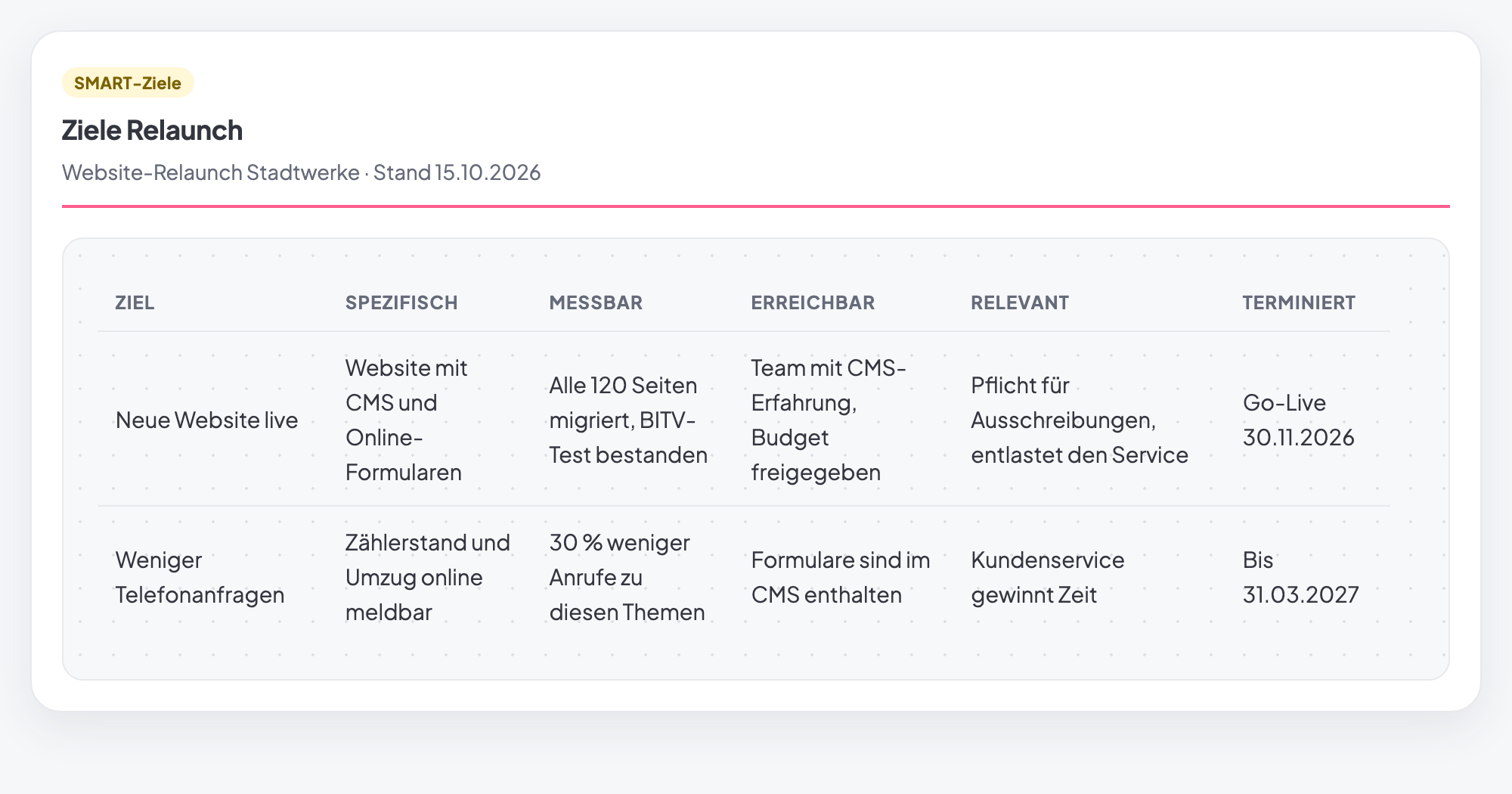
The screenshot above shows two goals that complement each other well:
- Output goal “New website live”: website with CMS and online forms. Measured by all 120 pages being migrated and the accessibility test passed. Achievable because the team has CMS experience and the budget is approved. Relevant as a requirement for tenders and to relieve customer service. Go-live on Nov 30, 2026.
- Outcome goal “Fewer phone inquiries”: meter readings and address changes can be reported online. Measured by 30 % fewer calls on these topics. Achievable because the forms are part of the CMS. Relevant because customer service gains time. To be reached by Mar 31, 2027.
A tip on the second goal: “30 % fewer” needs a baseline. Customer service should measure it before go-live, or the goal cannot be checked later.
Typical mistakes
- An action instead of a goal. “Introduce a CMS” is a path. The goal is what gets better afterwards.
- Not measurable. “More modern” or “more user-friendly” cannot be ticked off.
- No baseline. Without a starting value, “30 % fewer” cannot be verified.
- Too many goals. More than five project goals dilute the priorities.
- Written once, never looked at again. Goals belong in every status meeting.
SMART goals in Tasktopus AI
- As a table on the project: columns for goal, specific, measurable, achievable, relevant, and time-bound. You add one row per goal. Everyone in the project sees the current state.
- Suggested at project start: for new projects, SMART goals appear at the top of the method picker under “Fits the project now.” Next to them you find, for example, the project brief and the stakeholder analysis.
- Print as a sheet: the “Sheet” view shows the goals as a table, for example as an attachment to the project charter.
- Plan: included in all plans, including the free Starter.
Capture SMART goals for free
Included in the free Starter plan. No credit card, no installation.
Start for freeFrequently asked questions
What does the acronym SMART stand for?
Specific, measurable, achievable, relevant, and time-bound. Depending on the source, the A also stands for attractive or agreed, and the R for realistic.
What is the difference between SMART goals and OKRs?
SMART is a writing aid for a single goal. OKR (Objectives and Key Results) is a framework for setting goals for whole teams and reviewing them regularly. The two fit together well: key results are easy to phrase in SMART form.
Does every goal have to be SMART?
Project goals should be, because the project is measured against them. A vision, on the other hand, can be big and inspiring. The SMART goals are then derived from it.
Are SMART goals in Tasktopus AI free?
Yes. They are one of the 12 core methods in the free Starter plan. Starter stays free for good, for up to 3 projects and 5 members.