"I thought you were taking care of that." This sentence costs projects a lot of time. The RACI matrix prevents it by putting responsibilities on one page that everyone knows.
- Purpose
- Clarify responsibilities unambiguously
- When
- Once the work packages are set, and when new people join
- Who
- Project lead, agreed with everyone involved
- Result
- One table: activities in the rows, roles in the cells
What does RACI mean?
Each letter stands for a role that a person or group takes on for an activity:
- R – Responsible: does the work. There can be several Rs.
- A – Accountable: carries overall responsibility, decides and signs off on the result. There is exactly one A per activity.
- C – Consulted: is asked beforehand and contributes expertise. This is a two-way conversation.
- I – Informed: is told about the result or status but has no say.
Watch the wording: in everyday language, "responsible" can mean either R or A, depending on the source. In Tasktopus AI, R therefore stands for doing the work and A for the person who is held accountable. Agree once as a team on how you read the roles.
When is a RACI matrix worth it?
- When several departments or companies work together, for example agency and client.
- When tasks stall or get done twice.
- When new people join and need to see quickly who stands for what.
A team of three with clear roles rarely needs a RACI matrix. From about five people or one external partner, it almost always pays off.
Step by step
- List the activities. Work packages or key decisions, not every little thing. Six to fifteen rows are usually enough. A work breakdown structure is a good source.
- Define who is involved. People, roles or departments that contribute to the activities.
- Assign the A first. Who decides and signs off? Exactly one person per row.
- Then the R. Who does the work? Every row needs at least one R. A and R can be the same person.
- Add C and I sparingly. Only those who really need to be asked or informed.
- Check and agree. Go through rows and columns (see below) and discuss the matrix with everyone involved instead of just sending it out.
The check rules
- Row without an A: nobody decides. Row with several As: conflict is guaranteed.
- Row without an R: nobody does the work. Lots of Cs: every decision takes forever.
- Column with many Rs: this person is probably overloaded. Empty column: is the role needed at all?
Example: website relaunch
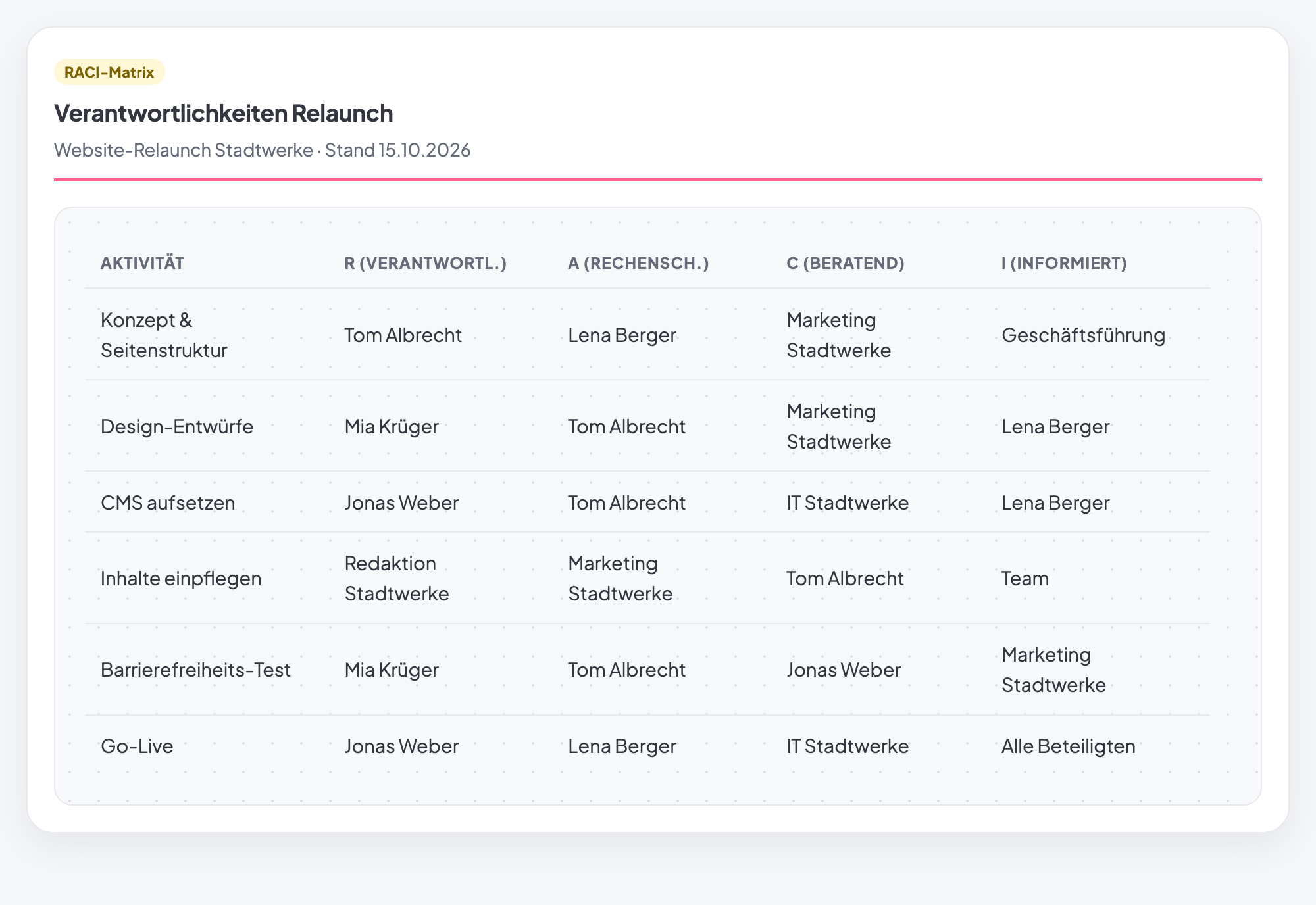
In the image above, an agency team distributes six activities from concept to go-live. Two things stand out:
- The client carries responsibility too: The utility company's editorial team enters the content, and its marketing department is accountable. This settles early on that copy is not the agency's job.
- One A piles up: Tom Albrecht is accountable for three activities. As project lead, that is intended. But if he drops out, the team knows right away where a stand-in is needed.
Common mistakes
- Several As in one row. Shared accountability often ends up meaning none.
- A committee as A. A "steering committee" doesn't decide quickly. Better one person who represents the committee.
- Everyone as C. If you ask everyone, you wait for everyone.
- Too fine-grained. Nobody reads a matrix with 80 rows.
- Not agreed. A matrix that one person creates alone and sends out is rarely lived.
RACI matrix in Tasktopus AI
- As a table on the project: columns for activity, R, A, C and I. Add one row per activity. Everyone on the project sees the current state.
- Print as a sheet: the sheet view shows the matrix as a clean table, for example for the kickoff.
- Suggested in an ongoing project: the method picker shows the RACI matrix under "Fits the project right now" once the project is running.
- Good to know: the matrix is a document on the project. Who completes an individual task is still set in the task itself.
- Plan: included in all plans, including the free Starter.
Create a RACI matrix for free
Included in the free Starter plan. No credit card, no installation.
Start for freeFrequently asked questions
Can A and R be the same person?
Yes. Especially in small teams, the accountable person often does the work themselves. What matters is that there is exactly one A per activity.
What is the difference between C and I?
C is asked beforehand and can influence the result. I is informed afterward. Rule of thumb: C is a conversation, I is a message.
What are RASCI and RACI-VS?
They are extensions. RASCI adds S for Support, meaning people who assist the R. RACI-VS adds V for Verify (checks) and S for Sign-off (approves). For most projects the classic RACI matrix is enough.
Is the RACI matrix free in Tasktopus AI?
Yes. It is one of the 12 core methods in the free Starter plan. Starter stays free forever for up to 3 projects and 5 members.