Many projects do not fail because of technology. They fail because of people who were asked too late. A stakeholder analysis makes sure you know everyone who matters before they speak up on their own.
- What for
- Spot everyone involved and involve them the right way
- When
- At project start, and again whenever the environment changes
- Who
- Project lead, ideally together with the client or sponsor
- Result
- List of stakeholders with influence, interest, and how to handle each
What is a stakeholder analysis?
Stakeholders are all people and groups with an interest in the project or affected by it. Internally, that includes management, departments, the project team, or the works council. Externally, think customers, suppliers, authorities, or the public.
The analysis rates each stakeholder on two criteria:
- Influence: How strongly can this person or group push the project forward or slow it down?
- Interest: How strongly are they affected or engaged?
Together, both tell you how to deal with someone. The visual version is called the power-interest grid:
- High influence, high interest: involve closely and align regularly.
- High influence, low interest: keep satisfied with brief, targeted updates.
- Low influence, high interest: keep informed. Valuable hints often come from here.
- Low influence, low interest: monitor, and keep the effort small.
Step by step
- Collect. Who is affected, who decides, who contributes, who could block? Better to write down too many at first.
- Get specific. Split groups when their interests diverge. “IT” and “the data protection officer” often want different things.
- Rate. Score influence and interest as high, medium, or low.
- Define the approach. Decide based on the rating: involve closely, keep satisfied, keep informed, or monitor.
- Plan actions. Who talks to whom, how often, and in what form? This becomes your communication plan.
- Review regularly. Influence and interest change, for example after a reorganization or shortly before go-live.
Example: website relaunch
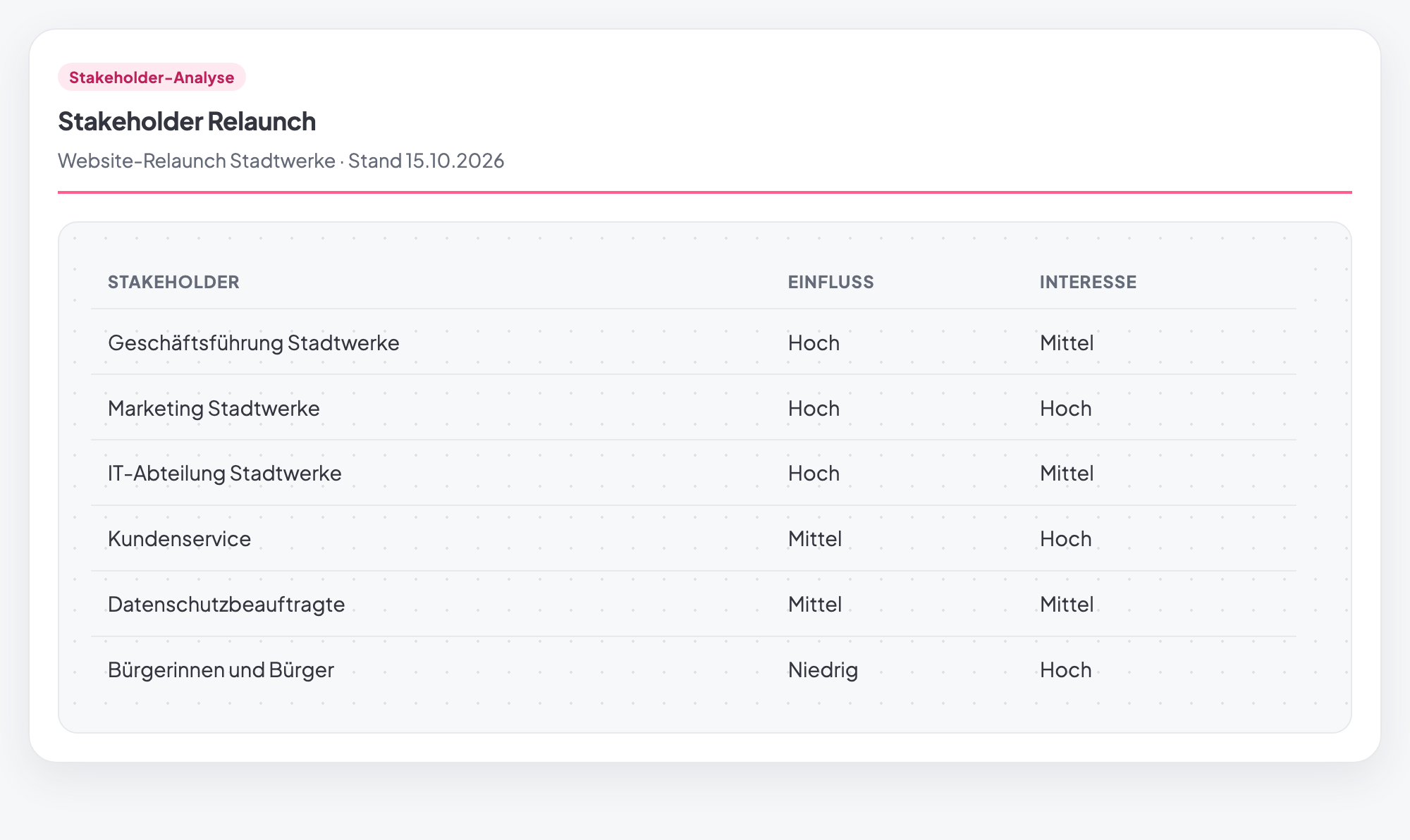
In the screenshot above, the project team has listed six stakeholders. Here is what follows:
- Municipal utility’s marketing team (influence high, interest high): involve closely, weekly check-in.
- Management (high, medium): keep satisfied with short status reports at every milestone.
- IT department (high, medium): involve early on hosting, before it becomes a bottleneck.
- Customer service (medium, high): keep informed and gather feedback on the new forms.
- Data protection officer (medium, medium): involve for the forms and the cookie notice.
- Citizens (low, high): inform them about the relaunch in good time, maybe with a small user test.
Common mistakes
- Forgetting silent stakeholders. Works council, data protection, or purchasing show up late otherwise, often with a veto.
- Collecting names only. Without a defined approach, the analysis has no effect.
- Groups that are too broad. “The customers” are rarely one uniform group.
- Getting personal. Many people read the analysis. State objectively what someone needs, not what you think of them.
- Creating it once, never updating it. A change in management can shift the whole picture.
Stakeholder analysis in Tasktopus AI
- As a table on the project: Columns for stakeholder, influence, and interest, each rated high, medium, or low. Everyone in the project sees the current state.
- Suggested at project start: For new projects, the stakeholder analysis appears at the top of the method picker under “Fits the project now”.
- Print as a sheet: The “Sheet” view shows the list as a clean table for workshops or your records.
- As a grid: If you need the visual version, add the power-interest grid (Pro and up). It shows every entry in a 3×3 matrix.
- Plan: included in all plans, including the free Starter.
Create your stakeholder analysis for free
Included in the free Starter. No credit card, no installation.
Start for freeFrequently asked questions
What is the difference between a stakeholder analysis and a power-interest grid?
The power-interest grid is the visual form of rating stakeholders by influence and interest. Tasktopus AI has both: the stakeholder analysis as a table in the free Starter, and the power-interest grid as a matrix from Pro up.
How many stakeholders are normal?
Small projects often have five to ten, large ones quickly reach twenty or more. What counts is not the number but that nobody important is missing.
Who should see the stakeholder analysis?
Usually the project team. Because judgments about people can be sensitive, phrase them so that every person concerned could read them.
Is the stakeholder analysis free in Tasktopus AI?
Yes. It is one of the 12 core methods in the free Starter. Starter stays free for good, for up to 3 projects and 5 members.